

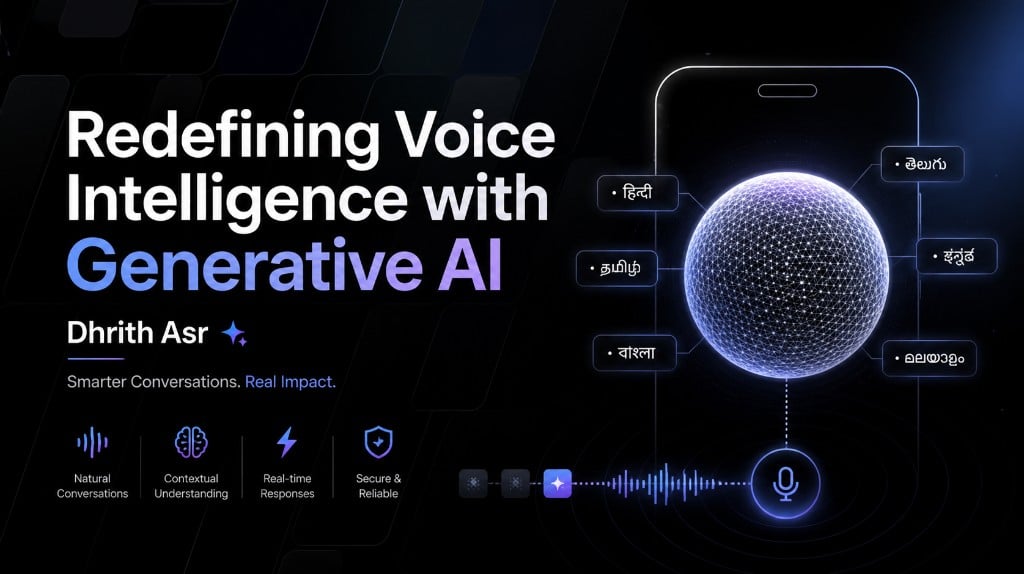
Dhrith: Emotionally Intelligent ASR for India’s Multilingual Voices
India has always been a land of languages. From one town to another, dialects, accents, and linguistic blends transform effortlessly - often merging Hindi and English in a uniquely expressive rhythm. Capturing this natural flow of multilingual conversation is not just a technical challenge; it is a cultural mission. Traditional Automatic Speech Recognition (ASR) systems have long focused on what is spoken - the literal words. But communication in India carries far more - how something is said often holds the true meaning. Tone, pace, emotion, and intent all weave together to form the heartbeat of a conversation. Dhrith, our next-generation ASR model, listens beyond words. It understands emotion, rhythm, and code-switched language - giving transcription not only linguistic precision but emotional depth. Dhrith transforms ordinary speech recognition into an emotionally aware experience, enabling applications that feel human, responsive, and deeply connected to India’s multilingual reality. By combining linguistic understanding with affective cues, Dhrith enriches conversations with context - bridging the emotional gap between humans and machines. This opens vast possibilities: from emotionally aware conversational AI and empathetic call analytics to the foundation of the next generation of Indic Text-to-Speech (TTS) systems.More About Dhrith
Dhrith is built and evaluated specifically for India’s multilingual, code-mixed speech patterns across Hindi, English, and Hinglish usage. Beyond literal transcription quality, it is designed to preserve emotional and conversational context in ways that traditional ASR systems usually miss.What makes Dhrith different
- Emotion-aware transcription: captures expressive cues such as tone, pace, and intent.
- Code-switch robustness: handles natural Hindi-English switching and regional variations.
- Context-rich outputs: balances word-level accuracy with meaningful emotional annotations.
Benchmarking approach
Our internal benchmark evaluates both linguistic and expressive quality using metrics like:WERandCERfor transcription accuracyNWERandNCERfor meaningful-content accuracy after filler filteringSERfor semantic faithfulnessETfor expression taggingCMfor code-mix fidelity
Real-world impact
- Customer experience: emotion-aware call analytics and better quality scoring
- Conversational AI: more responsive assistants with human-like understanding
- Media and education: better multilingual accessibility and transcription quality
- Research and insights: deeper analysis of spoken communication signals
Read the full deep dive
Examples
Below are all representative samples from the Dhrith benchmark article, with full transcriptions.Example 1
Example 2
Example 3
Example 4
Example 5
Example 6
Example 7
For additional samples (including commentary-style speech and numeric/entity-heavy audio), see the full blog:
Getting Started
Signup
Create your account to get started with TensorStudio